You wrote it down, now what?

A few days ago we posted an article entitled, don’t let your year so far write October’s story, the article can be found here, https://wisdomofgodwithwendy.org/dont-let-your-year-so-far-write-octobers-story/, if you have not read it, you should read it. Most folks told us that they read it and a few people tried it, but a few days later, what was read may have been forgotten or not followed up on because of so many competing distractions. So this article is a follow up on the previous article that can be found at the link above.
Tuesday has arrived and more than likely it arrived with ordinary sounds: a phone alarm, a sink full of dishes, another round of emails, another bill waiting to be opened. The page you wrote on is still nearby, but the circumstances may look exactly as they did before. The old thought may return quietly: “Nothing changed, so nothing will.”
Perhaps the hope you felt while writing has already faded beneath the weight of real life. Inspiration can be powerful in a moment, but Tuesday is real life. Bills still need attention. Bodies still hurt. Conversations still feel difficult. A job search can remain stalled, and a dream can still seem far away.
Maybe your page is still blank because you could not find the strength to write. Perhaps it is half-written, with a few hopeful sentences followed by a long silence. You might be looking at bills that do not stretch, a business that has not recovered, or applications that have received no response. Maybe you are waiting for a health situation to improve, carrying a strained marriage, or providing care for someone who needs you every day.

If this sounds familiar, you may be privately wondering how much longer you can continue carrying the same concern. Perhaps you feel quietly drained: by worry, by financial pressure, by a relationship that keeps taking more than it gives, or by a situation that becomes heavier every month you remain in it. You may even be asking, “What is going on?” while trying to keep functioning as though everything is fine.
Here is why taking up the pen again matters: writing is not a way to control God, and action is not a way to force His hand. It is a way to bring your attention, honesty, prayer, and willingness before Him. God gives direction; you take the step. The outcome remains in His hands, but today’s action can still belong to you. As you begin, clarity, courage, wise counsel, new information, or a necessary redirection may begin to show up.

1. The Tuesday After the Blank Page
The letdown deserves to be named gently. You may have felt encouraged when you wrote your hopes down, but encouragement does not always remain at the same emotional level. The page did not fail because Tuesday felt ordinary.
The vision was not the finish line. It was the starting gun.
Writing something down did not mean that every circumstance would change overnight. It meant that you paused long enough to notice what you were carrying and what you were willing to place before God. Nothing about the page was wasted. Even if the page is still blank or the situation is still hard, your honesty mattered.
You did not have to be naive to hope. You may simply have been willing to imagine that your life could hold something different from what has happened so far. That willingness is worth protecting, not with false certainty, but with faith, wisdom, and steady action.
2. “Nothing Changed, So Nothing Will”: The Lie That Stops the Rescript
Galatians 6:9 gives language for the middle of the process:
> “Let us not become weary in doing good, for at the proper time we will reap a harvest if we do not give up.”- Galatians 6:9, NIV
This verse does not pretend that waiting is easy. It does not give you a timeline. It does not say that every outcome will look exactly as you hoped. It does call you away from the conclusion that today’s lack of visible change has already written the ending.
The honest reframe is not, “Everything has changed.” Perhaps it has not. The honest reframe is, “Nothing has changed yet, but I do not have to surrender every possibility to what I can see today.”
As the previous article, “Don’t Let Your Year So Far Write October’s Story,” reminded you, yesterday can inform you without defining you. Your history can teach you where you need wisdom, boundaries, healing, or support without becoming a permanent identity.
If you wrote something down it is proof that you still want a life beyond survival. That want is not naive. It is evidence. It may show that worry has not completely silenced your desire for purpose, peace, health, meaningful work, honest relationships, or renewed faith.
Have faith in God, but do not confuse faith with pretending. You can acknowledge the unpaid bill and still pray. You can admit the relationship is strained and still ask God for wisdom. You can say, “This is not better yet,” without saying, “It can never be different.”
3. The Vision Is a Compass, Not a Contract
Habakkuk 2:2–3 gives us the central picture for this season:
> “Then the LORD replied: ‘Write down the revelation and make it plain on tablets so that a herald may run with it. For the revelation awaits an appointed time; it speaks of the end and will not prove false. Though it linger, wait for it; it will certainly come and will not delay.’”- Habakkuk 2:2–3, NIV
Notice the movement: write it plainly, remain attentive, and wait for God’s appointed time. The passage does not describe writing as a contract that obligates God to follow your preferred outline.
You did not sign anything. You aimed your heart.
God is free to redirect, refine, or reveal something different. That is not necessarily failure. It can be part of an ongoing relationship in which you remain willing to listen. You may begin with one picture of the future and discover that God is shaping your desires, correcting your assumptions, or leading you toward a path you could not yet see.
God alone determines the how, when, and where. You are not responsible for managing other people’s decisions, manufacturing a harvest, or forcing a door open. Your responsibility is to remain honest before God and faithful with what is actually in your hands.
Proverbs 16:3 offers a steady prayer:
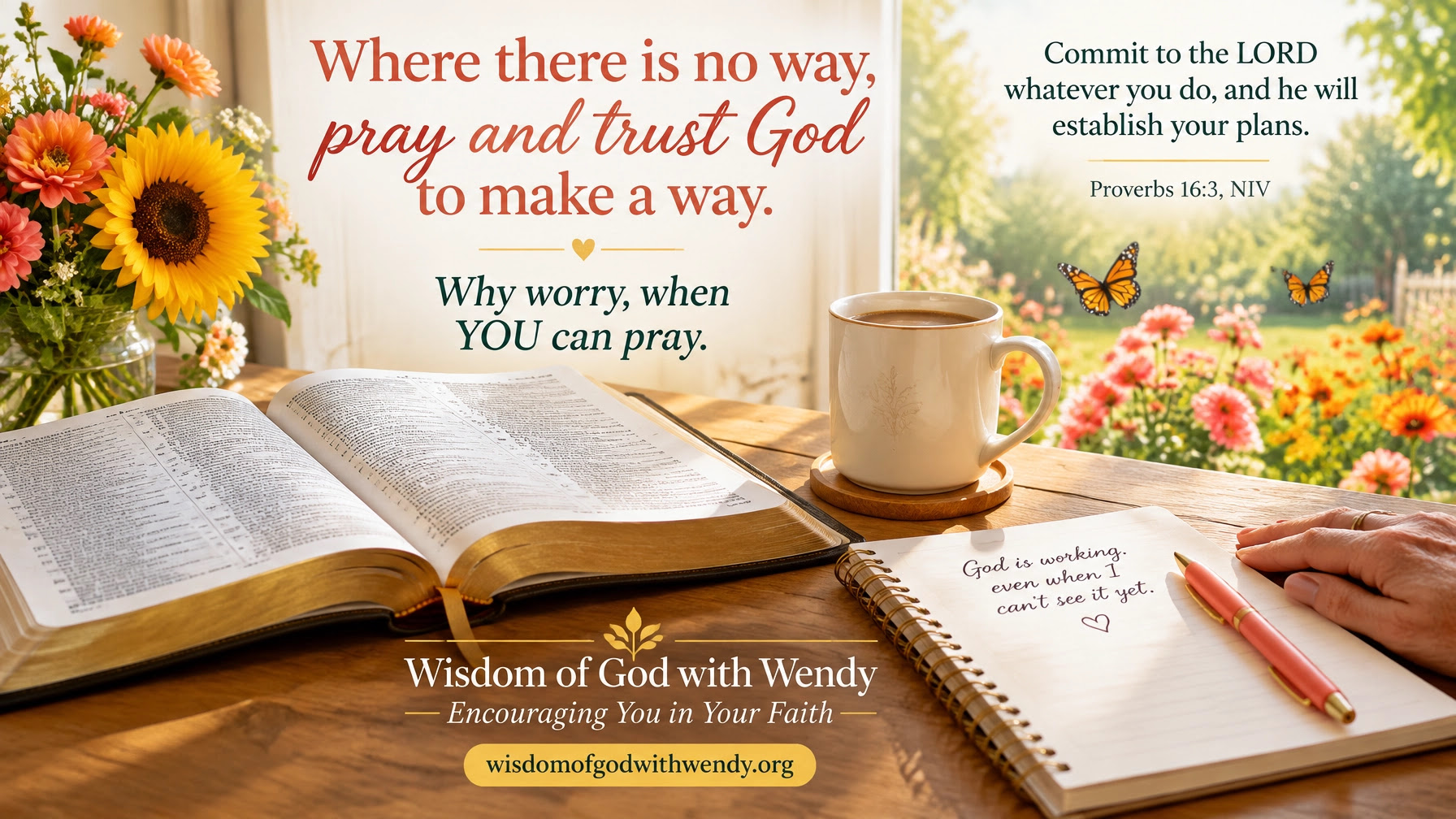
> “Commit to the LORD whatever you do, and he will establish your plans.”- Proverbs 16:3, NIV
4. The Action Section: What Belongs to God and What You Can Take Up Today
The next step is not passive waiting. It is active trust without pretending that you control the result.
Start with the steps before you measure the benefits. You do not need to solve your entire life this week. You may need only one faithful action.
- Look honestly at one area of pressure.
Choose one bill, one medical concern, one relationship question, or one unfinished responsibility. Name what is true without panic. If finances are draining you, examine the numbers carefully. Cut one unnecessary expense if possible, ask whether one bill can be renegotiated, and speak with someone who understands money better than you do.
Benefit of inviting God into this step: honest information can reduce the fear created by guessing. It may also show you where you need help, a boundary, or a different plan. - Take one practical step toward the written hope.
Send one application. Book one appointment. Make one business call. Gather one document. Pick up one habit you had abandoned. Add one line to the page.
Benefit of inviting God into this step: a small action can return you to agency. You are no longer only observing your circumstances; you are responding to them with prayer and wisdom. - Open one necessary conversation.
Perhaps you need to ask for clarification, state a boundary, request a payment arrangement, or tell someone honestly what you can and cannot carry. You do not have to make the conversation dramatic. You can begin with one calm sentence.
Benefit of inviting God into this step: prayer may help you speak with greater honesty and restraint. It may also help you recognize when silence is protecting peace and when silence is protecting fear.
- Ask one wise person for counsel.
This could be a trusted friend, pastor, counselor, financial professional, doctor, mentor, or mature family member. Asking for help is not proof that you have failed. It may be one of the most responsible actions available to you.
Benefit of inviting God into this step: wise counsel can help you see options that exhaustion has hidden. Proverbs 15:22 says, “Plans fail for lack of counsel, but with many advisers they succeed.”- NIV - Keep one promise that supports your health and attention.
Take one hour of rest. Drink water. Attend the appointment. Put down the phone. Go outside. Pray for one hour if that is possible, or pray honestly for five minutes if it is not.
Benefit of inviting God into this step: rest can help you respond rather than react. Your body and mind are part of the life you are asking God to guide. - Keep a simple record.
Write the date, what you prayed, what step you took, what changed, and what remains unresolved. This is not a scorecard for God. It is a record of your walk with Him.
Benefit of inviting God into this step: a record may help you notice growth, repeated patterns, new information, and prayers that need to be revised.
There is no prosperity formula, no seed-sowing requirement, and no guarantee attached to these actions. The work may be yours, but the results are God’s. You can act faithfully without claiming that your action forces God to produce a particular outcome.

5. For the Reader Who Can Barely Move
Maybe you are too sick, too grieving, too depressed, or too depleted to take a large step. Do not let this article become a whip for the exhausted.
The smallest faithful step counts. One sentence written. One prayer prayed honestly. One glass of water. One call answered. One nap taken without guilt. One appointment requested. One safe person told, “I need help.”
God loves you. God is near. When no one else cares for you, God cares for you. Your worth is not measured by how much you accomplish while you are hurting.
If all you can say is, “God, help me get through today,” that can be a real prayer. Why worry, when you can pray? Prayer may not remove every responsibility immediately, but it can give you a place to tell the truth and receive enough strength for the next moment.
6. Return to the Page: Weekly, Not Perfectly
Set aside ten minutes once a week. It can be Tuesday morning, Sunday evening, or any time that fits your life. Use a handwritten journal, an online journal, a notes app, or a single document on your computer.
Add one honest line:
- “God, this is what felt heavy this week.”
- “God, this is one step I took.”
- “God, this is what I still do not understand.”
- “God, this is what shifted, even slightly.”
- “God, please redirect me if I am holding too tightly to the wrong outcome.”
The page is a record of your walk with God, not a contract you are failing to fulfill. You do not need perfect consistency. You can return after missing a week, a month, or longer.
Luke 16:10 says:
> “Whoever can be trusted with very little can also be trusted with much, and whoever is dishonest with very little will also be dishonest with much.”- Luke 16:10, NIV
Small faithfulness has value even when nobody applauds it.

7. What You May Begin to Notice
The first signs may be small and real rather than dramatic.
You may notice that a decision that once paralyzed you finally gets made. A bill you were afraid to open may lose some of its terror because you now know the number. One conversation may lighten something. One appointment may provide information. One application may reopen your willingness to try.
A step taken from the couch may reveal a door you could not see from the couch.
God answers prayers, but an answer may involve direction, wisdom, patience, correction, support, or a changed heart, not always an immediate change in circumstances. God’s miracles are possible if you pray, but prayer is not a transaction that gives you control over the timing.
It may not have changed by next Tuesday. You may still be waiting. Even so, you may recognize that you are no longer standing still in the same way. You are praying, listening, gathering information, making decisions, asking for help, and giving God room to guide you.
Proverbs 3:5–6 offers this reminder:
> “Trust in the LORD with all your heart and lean not on your own understanding; in all your ways submit to him, and he will make your paths straight.”- Proverbs 3:5–6, NIV
8. The Rescript
Staying in a situation that is draining you, worrying you, or breaking you financially is not automatically faithfulness. Sometimes the faithful thing is the brave thing: asking a hard question, seeking counsel, setting a boundary, changing direction, or admitting that the current arrangement cannot continue as it is.
You are allowed to weigh that choice honestly with God. Leaving a harmful or unsustainable situation is not necessarily failure. Staying while you gather wisdom is not necessarily failure either. You do not have to turn your decision into a performance for anyone else.
You do not have to keep living in the unfinished version of your life simply because it is familiar.
Take up the pen again. Write the next honest line. Examine the next number. Make the next call. Rest when rest is needed. Ask God for direction, and then take the step that belongs to you.
The outcome remains in God’s hands. But you are not a passenger in your own life.

Say This Out Loud
> “Yesterday can inform me without defining me. God is near, and I can take the next faithful step.”
> “I will not pretend that everything has changed. I will trust God with the outcome and remain faithful with what belongs to me today.”
For continued encouragement about walking with God through difficult decisions, you can also visit Wisdom of Jesus with Wendy.
Let Us Pray Together
> God, You know what this year has carried. I’m taking up the pen again. Guide my next step, and give me courage to take it. I leave the outcome in Your hands. Amen.
One clear action for today: Set a timer for ten minutes, return to the page, and write one honest sentence beginning with, “God, the next step I can take is…”
You may not have the whole answer yet, but you can bring God your honest page. God loves you, God is near, and God is not finished with you yet.
Encouraging You in Your Faith
Please follow WIN International Ministries on our social media networks for continued encouragement, prayer, and faith-filled support.